Showing posts with label Rice/Noodles. Show all posts

Sunday, April 6, 2008

Bamboo Rice

My mom loved to cook, and everything she made tasted good, but of course, there were a few favorites. One of my younger brother's favorites was bamboo rice. It's a simple dish, but it's so good. I remember when we were kids, my brother who normally only ate a bowl of rice ate 3 or 4 bowls when my mom cooked bamboo rice.

IN JAPANESE: Takenoko Gohan
CATEGORY: Rice/Noodles
COOKING METHOD: Stir-fry
DIFFICULTY: Medium
SERVES: 4 people
LENGTH OF TIME: 45 min

INGREDIENTS:
2 Cups of rice
1/2 lbs of ground beef or pork or chicken
1 can of green bamboo shoots
1/4 carrot or 4 baby carrots chopped thin
3 TBsp soy sauce
2 TBsp sake
1 TBsp mirin
1 TBsp sugar
1/2 tsp dashi powder
1 half inch piece of ginger (see TIP: Ginger)

HOW TO:
Wash 2 cups of rice and set it on your rice cooker with slightly less than regular water measurement. For extra flavor, I add a couple shake of dashi powder to the cooker for this partiuclar dish.

While the rice is being cooked, open up the can of bamboo shoots. You can find these at most Asian groceries, or bigger supermarket on the Asian food isle. There are pre-chopped sliced kinds, but I like getting the whole ones and chop them into chunkier pieces like shown on the photo. Also chop some carrots into thin slices.

Heat up the frying pan, add some oil and cook your choice of ground meat on medium high. While the meat is still half cooked, go ahead and add the carrots and bamboo.

Add sake, soy sauce, mirin, sugar, ginger (shredded) and 1/2 teaspoon of dashi powder and stir well. When everything is mixed (should only take a minute), change the heat to low, and place a lid and let it simmer and have the flavor soak into bamboo and meat for about 5 minutes. Make sure the heat is low enough that all the liquid doesn't dry up.

After about 5 minutes, most of the liquid should be gone (it's ok if there's some, just as long it's not more than 5 TBsp of it.

When the rice is finished cooking, mix all of the bamboo and ground meat mix into the rice and serve!

Friday, March 7, 2008

Crab Lettuce Fried Rice

Wow. It's been over a year now since the last blog entry. I hadn't updated this blog or answered people's comments, but recently I've noticed a sudden surge of traffic to this blog and some nice comments from people that have tried my recipe. Thanks!

So, I decided to start this blog again. Not sure how often I can update it, maybe once a week, but realistically let's say at least a couple of times a month. And to celebrate this re-start of this blog, I wanted to do something fancy, but I knew that would delay my start again, so I'm going with another easy recipe. I guess this is why this blog is called Easy Japanese recipes.

IN JAPANESE: Kani Lettuce Cha-han
CATEGORY: Rice/Noodles
COOKING METHOD: Stir-fry
DIFFICULTY: Medium
SERVES: 2 people
LENGTH OF TIME: 15 min


INGREDIENTS:
2 bowls of rice
1 can of crab meat (or shrimp for cheaper alternative)
4-5 Finely chopped shrimp (optional)
1/2 onion
1 egg (beaten with 1 TBsp of crab juice from the can)
1/2 TBsp vegetable oil
1/2 TBsp sesame oil
1 half inch piece of ginger (see TIP: Ginger)
1 green onion finely chopped
1 TBsp mayonaise
2 handful of lettuce leaves
some salt
some pepper

HOW TO:
This is another great thing to cook when you have some leftover rice. On a heated wok, pour both vegetable and sesame oil. When the oil is well heated, saute the onion until it is well cooked, and add the chopped shrimp now if they are raw (if they are pre-cooked ones, add it when you add the crab later).

While that is being cooked, beat the egg with some crab juice from the can (about 1 table spoon) in a separate bowl. When the onion (and raw shrimp) are mostly cooked push them to one side of the wok, and scramble the egg on the open side of the wok.

When the egg is fully cooked, add the rice, chopped green onion, crab meat (and cooked shrimp if you are adding) and a tablespoon of mayo and mix well. Don't worry you won't taste this mayo. It's mostly in there to give it a bit of shine. When all that is mostly mixed, add the lettuce. How much lettuce? I normally tear a few leaves to be about a little larger than a bite size (they shrink), and I add one handful of that per serving (so in this case, two handfuls, which is about 1/4 of the whole lettuce).

Right after the lettuce is added, shred the ginger, shake some salt and pepper to your liking and serve. I tried to serve it by putting it in a bowl first and flipping that out onto a plate to make it look like regular fried rice presentation, but for this one with lettuce in it, it's better to just scoop and serve on a plate.

Sunday, July 23, 2006

Italian Fried Rice

There was Bite of Seattle this weekend at Seattle Center, so we checked it out with a few of our friends. I'm always excited about this event, but every year, I seem to remember that it wasn't that exciting. For those of you that don't know, this event just has lots of food booths from various restaurants in Seattle. You can try tasting lots of different foods, but every year we end up eating the simlilar thing, instead of being bold and try something unique like an alligator on a stick. This year I tried spicy BBQ pork sandwich and collard green, which was pretty good.

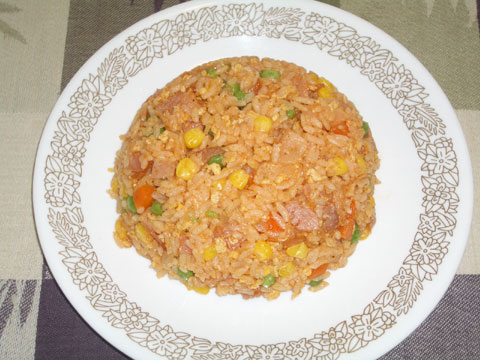
Speaking of unique food, here's a dish that sounds interesting. In Japan, a lot of little cafe offer this dish as chicken rice. You usually find this inside an egg omlet in Japan (called Omu-rice). I never had any particular name for this dish, but for this post, I decided to call it Italian Fried Rice. My wife was completely against the idea since there is nothing Italian about it, other than that I use a little of garlic and ketchup. But I think Italian fried rice sounds more appetizing than ketchup rice.

IN JAPANESE: Chicken Rice
CATEGORY: Rice/Noodles
COOKING METHOD: Stir-fry
DIFFICULTY: Medium
SERVES: 2 people
LENGTH OF TIME: 15 min


INGREDIENTS:
2 bowls of rice (leftover would be better as opposed to freshly made)
your choice of meat (chicken, bacon, ham, etc) cut in tiny pieces
1 clove of garlic chopped finely
1 TBsp of vegetable oil (omit if you are using bacon)
1 egg
1 teaspoon of sugar
1/2 cup of frozen vegetable
1/4 onion chopped finely
1/2 cube of chicken bouillon
1 teaspoon of butter
4 TBsp of ketchup

HOW TO:
On a heated wok, pour a table spoon of vegetable oil. When the oil is well heated, add the finely chopped garlic, and let the garlic flavor soak into the oil. Then cook your choice of meat along with the onion.

After your choice of meat and onion are mostly cooked, add 1/2 cup of frozen vegetable. While that is being cooked, beat the egg with the sugar in a separate bowl. When the vegetables are mostly cooked push them to one side of the wok, and scramble the egg on the open side of the wok.

When is egg is fully cooked, mix that with the rest of the stuff in the wok, and add the rice, and 1 teaspoon of butter, and a 1/2 cube of chicken bouillon powder (be sure to smash that into tiny pieces and sprinkle them over evently).

After everything is mixed fairly evenly add the ketchup until everything is evenly red.

Sunday, July 16, 2006

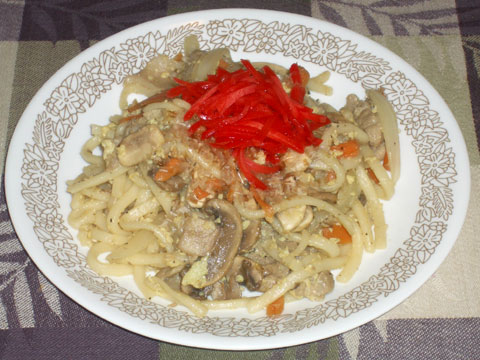
Yaki Udon

There was a Japanese Bon-Odori festival this weekend near the International District. My wife and I, and a couple of other friends that used to teach English in Japan went to check it out. The guys wore jimbei, which is a traditional summer wear for males, and the girls wore yukata, traditionally worn by women in the summer time. But recently there are cute Hello Kitty jimbei for girls and simple yukata for guys.

We enjoyed some festival foods like somen, yakisoba and teriyaki. There was a taiko drum show, which rocked, and we danced (or pretended like we danced) to bon-odori, a traditional Japanese summer festival dance. It was a lot of fun. On our way home late at night, we walked past some frat guys that were on their way to hit the clubs. One of them saw us in our jimbei and yukata, and yelled, "Memoirs of Geisha!" I was impressed that he was able to get the country right.

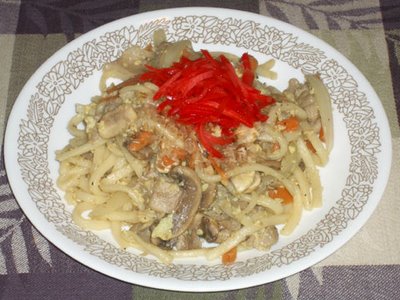
Yakisoba is a popular festival food, but I also enjoy yaki udon once in a while. It's fairly easy to make, and has more simple taste than yakisoba.

IN JAPANESE: Yaki Udon
CATEGORY: Noodles
COOKING METHOD: Stir-fry
DIFFICULTY: Medium
SERVES: 2 people
LENGTH OF TIME: 15 min

INGREDIENTS:
1 pack of udon
4 slices of bacon or thinly sliced pork
1 egg
1/4 onion
some carrots
some mushrooms
1 TBsp of vegetable oil
1 half inch piece of ginger (see TIP: Ginger)
1/2 TBsp of sugar
1 TBsp of soy sauce
some salt
some pepper
some pickled ginger (optional)
some fish flakes (optional)

HOW TO:
If you have the dried udon noodle, you need to boil and cook it as instructed. But I recommend that you use the non-dried kind. A lot of times, these noodles will come with a packet of soup power, but for yaki udon, you won't be needing that.

Pre-heat your wok and pour about a table spoon of vegetable oil. When the oil gets warm, stir fry your choice of meat, and then vegetables. On a bowl, mix egg with 1/2 table spoon of sugar (or mirin).

When the meat and vegetables are mostly cooked, push them aside, and pour the egg and scramble well. After the egg is cooked, mix well with meat and vegetables.

Add udon in the wok, and stir fry for about a minute. Shred a piece of gigner, pour 1 table spoon of soy sauce, and add some salt and pepper to your taste.

Serve with pickled ginger and fish flakes on top.

Friday, May 19, 2006

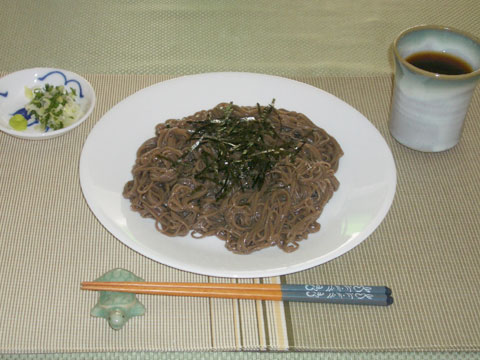
Soba (cold)

I have a great story about cold soba noodles. When I lived in Japan, one of my Japanese friends started dating a Navy guy. We were looking for a place to eat for lunch, and decided to eat soba since this guy has never had it before. It was a fairly warm day, so we suggested that he try the cold tempura soba, since that was the restaurant's speciality. He was one of those easy going guys that was willing to try anything. The only thing I was worried about was that most of the Americans I know (including my wife) aren't a huge fan of cold noodles. But he still said he would try it. The rest of us ordered hot soba noodles or katsudon.

When the food arrived, my friend and I were caught up in some conversation, and didn't think to show the guy how to eat soba properly. He picked up the cup with soup in it, and tried to pour that over the noodles. Luckily, we caught him before he made a huge mess, and told him that he was supposed to put the noodles in the soup cup instead. My friend and I went back into our talk until we heard, "Oh man, it's not gonna fit." He was trying to shove all of the noodles into a tiny cup, and now the soup was flowing out from the top (he still managed to put about a third of noodles into a tiny cup).

OK, so I didn't tell him that you are supposed to take a small portion of the noodle and dip that into the soup each time. But come on, do the math! We were trying to be nice about it, but I just couldn't stop laughing. On top of that, he started eating tempura with his bare hand as if they were chicken strips. Despite of being laughed at, he said he enjoyed the soba, but maybe he will try the hot noodles next time since it looked much easier.

IN JAPANESE: Zaru soba
CATEGORY: Rice/Noodles
COOKING METHOD: Boiled
DIFFICULTY: Easy
SERVES: 1 person
LENGTH OF TIME: 10 min

INGREDIENTS:
1 bunch of soba noodles
2 TBsp of soba tsuyu soup base
chopped green onions (optional)
some wasabi (optional)
some dried nori (optional)

HOW TO:
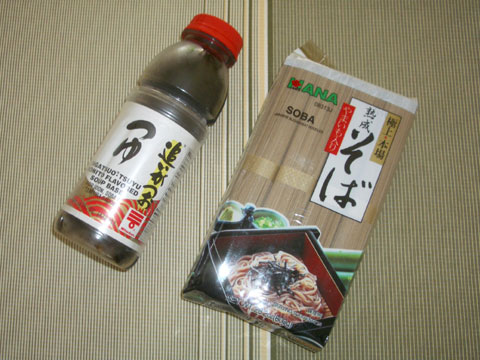
To make this, you need to get some soba noodles. These are dried noodles, so they will last for a while. If you know you won't be eating much, there are smaller packages available.

I used to make soup stocks from scratch, but that takes a while (since you need to heat it up, and then cool it down), so I recently started using the soup mix, which wasn't bad. It's definitely easier.

Boil one bunch of soba noodles in a pan of boiling water. If your soba noodles didn't come pre-bunched, then you are out of luck! You are just gonna have to look at the back of the package to see how many servings are in the bag, and divide it accordingly. I know... that's pain.

While the noodle is being cooked (it should be about 5 minutes, but check the package direction, too), pour about 2 tablespoons of tsuyu soup into a soup cup. If you don't have a soup cup (like me), use the fanciest looking coffee cup that you have, or regular glass would work, too. Tsuyu soup usually needs to be diluted 3 to 4 times with water. So if you are using 2 tablespoons of tsuyu, add 6 to 8 table spoon of water.

I like lots of "topping" with my soba, so I chop some green onions and add a little wasabi into my soup. If you have fresh shiso leaves, those are great for topping, too. Just be sure to dip the noodles into the soup instead of otherwise!

Monday, May 15, 2006

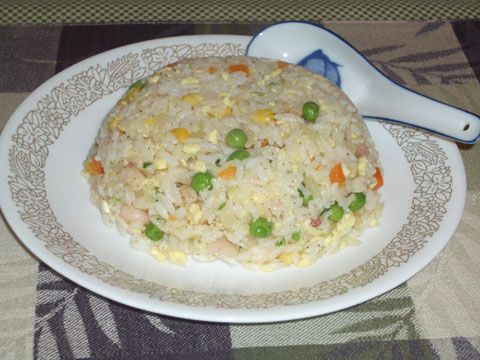
Fried Rice

I went to a music/comedy event at University of Washington this past weekend. Mos Def, Mixmaster Mike (of Beastie Boys), Phantom Planet were some of the musicians that performed. Music wise, I was most impressed by a hip-hop unit called Blue Scholars. I had never even heard of them before, but they are apparently Seattle's up-and-coming one MC, one DJ duo. I guess their album available on iTunes, so they must be fairly popular.

For this event, I was mostly looking forward to see Carlos Mencia perform his standup. I recently caught him on Comedy Central and thought he was entertaining. When he came on the stage, the crowd got into it, but I noticed a few people booing and shouting, "you suck!" and "you are stupid!!" He tends to do a lot of racial jokes, so I guess some people found him offensive. Before he took a break, he apologized to the audience that his intension is not to hurt people's feelings, but he's a comedian, so it's his job to be stupid and make fun of things, and that they shouldn't take him seriously. It was kind of weird. I guess at events like these, not everyone is going to be his fan.

Today, I'll introduce fried rice. I guess this is more of a Chinese food than Japanese, but fried rice and ramen (and gyoza) are considered a standard set in Japan, so I figured it's ok. There are packets of fried rice powders, and I have tried them before, but who knows what kind of chemical is in there.

IN JAPANESE: Chahan
CATEGORY: Rice/Noodles
COOKING METHOD: Stirfry
DIFFICULTY: Medium
SERVES: 2 people
LENGTH OF TIME: 15 min

INGREDIENTS:
2 bowls of rice
1/2 cup of mixed vegetable
1/4 onion
some shrimp or meat
1 egg
1 TBsp vegetable oil
1 half inch piece of ginger (see TIP: Ginger)
1 TBsp soy sauce
some salt
some pepper

HOW TO:
I usually make fried rice when we make too much rice, and I need to store the leftover rice in a fridge for a day or two. Those actually work better than freshly made rice when cooking fried rice.

Pour about a table spoon of oil into a wok or pan and cook your preferred meat or shrimp. If you are using bacon, (which is what I used), you don't need to use any oil, as bacon gives plenty of oil for cooking. I recommend using bacon, sausage, ham or shrimp for fried rice as those already have salty flavor. After about a minute, add onions to the pan.

After your meat/shrimp look mostly cooked, add the frozen vegetables and cook until most of the water evaporates.

Push the meat and vegetables to one side of the pan, and cook the egg on an empty space you have just created. If I'm not using sausage or bacon that's already salty, I normally add a bit of salt to the egg as I scramble it into tiny tiny pieces.

Then add the rice to the wok/pan and mix. When the rice is evenly mixed together with meat and vegetables, shred the ginger on top and add the soy sauce and pepper to the mix. Taste test to see how it tastes, and if needed, add some salt.

If you want to serve kind of fancy like the photo, scoop the fried rice into a little bowl, press gently, and place it upside down on a plate.